Should You Clean the Moss or Algae Off Your Roof? A Wisconsin Homeowner's Guide

Key Takeaways
Black streaks on a Wisconsin roof are almost always algae, which is cosmetic. Cleaning isn't necessary unless the roof is street-facing, being sold, or flagged by an insurer.
Raised green moss is different: it holds water against the shingle, can lift shingle edges, and shortens roof life if left untreated. Address it early.
Pressure washing voids your shingle warranty. If a cleaner mentions “pressure,” stop the call.
Fix the cause (shade, drainage, debris) before you fix the look, or you're rebooking cleaning service in 2–4 years.

Is Roof Algae the Same Thing as Moss?
Not even close, even though they get lumped together constantly. Algae is a thin, dark growth that mostly affects how a roof looks. Moss is a thicker, raised growth that actually holds water against the shingle and can lift or curl the edges over time. Moss causes moisture damage, not just an appearance problem.
The Asphalt Roofing Manufacturers Association's own position is that there's no scientific evidence algae damages a conventional asphalt shingle by itself. Moss is the exception: it retains water, can lift or curl shingle edges, and raises the risk of wind blow-off and water intrusion the longer it sits.
That distinction matters more here than it would in a milder climate. Water trapped under a moss mat goes through dozens of freeze-thaw cycles over a Wisconsin winter, and moss (or shingles it's already curled) on a shaded roof plane holds snow and ice longer than the rest of the roof, one of the classic conditions behind ice damming.
One more note before we go further: this guide is about asphalt shingle roofs specifically. Moss and algae behave differently on metal roofing, so if that's your roof, this isn't the guide you need.
Can Roof Algae or Moss Affect Your Homeowners Insurance?
Buyer objections when listing a home are real. And insurance non-renewal letters are often triggered by aerial or drone inspections. As United Policyholders has documented, some homeowners have received non-renewal notices over roof staining that turned out to be entirely cosmetic.
If you're selling and your roof has algae: with less than 5 years of life left, replacing before you list is usually the better move. With more than 10 years left, a cleaning is probably the right call instead. Either way, loop in your realtor since the right answer depends on your specific listing.
Case Study: How a Letter From an Insurance Carrier Got Resolved
One of our customers, Jennifer, in Stoughton got a non-renewal letter over roof algae staining. The roof plane facing north was shaded most of the day by a mature oak canopy, and gutters that backed up with leaf litter every fall kept that slope damp long after the rest of the roof had dried, creating classic algae conditions. We inspected the roof, confirmed the growth was cosmetic with no loss of shingle integrity, documented what we found, and sent her insurance carrier a letter confirming the roof's actual condition. The carrier retracted the non-renewal.
When Is Roof Algae Actually Worth Cleaning?
Here's the rough field-triage version:
Light streaking with no other symptoms: optional, mostly a curb-appeal call.
Algae clearly visible from the street or curb: worth a low-pressure chemical treatment (more on why we say “chemical,” not “pressure,” below)
Any raised moss: treat it promptly
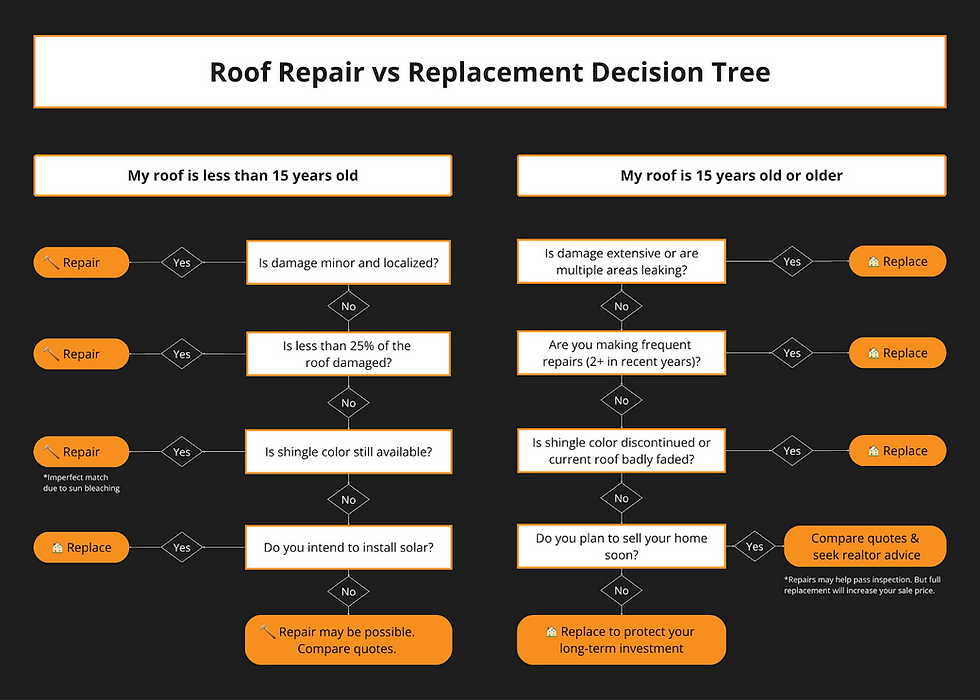
Moss with lifted or curled shingle tabs, or visible granule loss: skip cleaning and go straight to a repair conversation.
A roof that's near the end of its life anyway: Don't worry about cleaning, and start talking about replacement
If you're not selling and the algae is confined to a slope nobody can see from the street, there's no reason to clean it.
Does Pressure Washing Damage a Roof?
Yes. Pressure washing and abrasive brushing strip the granules off a shingle, and it voids your shingle warranty: both the manufacturer's coverage and our own workmanship coverage. If a cleaner mentions “pressure” on the phone, that's the point to stop the call.
What correct treatment actually looks like: inspect first, apply a low-pressure chemical treatment rather than abrasion, let the dead moss or algae release on its own over the following weeks, then reinspect. This approach doesn't damage the roof to get there.
Bleach runoff onto landscaping is a real cost too. Anything near planting beds needs protection before treatment starts, not cleanup after.
When Should You Replace a Roof Instead of Cleaning It?
Case Study: When Repair Costs as Much as Replacement
Our customer Dylan in Edgerton had moss that had already compromised shingle integrity on two separate back-of-house roof sections. The landscaping directly below was pristine, sensitive, native planting, which ruled out anything but the most careful chemical treatment, and even that wasn't cheap once you factored in protecting the plants, with no guarantee it would fully work.
We estimated roughly 5 years of usable life left on that roof. Once we ran the numbers, isolated repair plus careful cleaning priced out close to the cost of just replacing those two sections — and replacing only two sections on a roof that was due for full replacement soon anyway didn't make much sense either. So Dylan decided to replace the whole roof early, and brought in a certified arborist to prune the affected tree's dead limbs, opening up the sunlight and airflow that had been keeping that section damp, without touching the sensitive plantings below.
Once moss has actually compromised shingle integrity, “just clean it” stops being one of the real options on the table. At that point it's a choice between a repair that costs about as much as replacement, or a replacement that solves the root cause at the same time.
How Much Does Professional Roof Moss/Algae Removal Cost in Madison?
Expect somewhere between $400–$600 for a smaller, algae-only job, up to $700–$1,000+ for something larger, steeper, or heavier with moss and lichen. The Edgerton case above is the extreme end of that math: sensitive landscaping alone can push a “careful” cleaning close to repair or replacement cost.
A cleaning done properly should include a pre-inspection, written confirmation that no pressure washing will be used, a plant-protection plan for anything nearby, and a post-treatment condition report. That's not a short list, and it's worth knowing before you call around, because once you see everything a cleaning actually requires to do right, “skip it” or “just replace it” starts looking like the more sensible option a lot of the time. That's really the point of this whole guide: cleaning isn't free, isn't simple, and usually isn't the best move.
What Causes Moss and Algae to Keep Coming Back?
Three things drive it, almost always: shade from tree canopy, debris sitting in gutters and valleys, and poor drainage that keeps a section of roof damp longer than the rest. Fix the look without fixing one of these and you're paying to do this again in two to four years.

Roof-to-wall intersections and dormer transitions are worth a specific look too. They're common spots where drainage often goes wrong, well before anything is visible from the ground.

Algae-resistant shingles are worth knowing about as a forward-looking prevention layer for whenever you do re-roof, but unfortunately they're not a fix for growth that's already there.

Do New Shingles Automatically Come With Algae Resistance?
Often, but not automatically. Copper-granule algae-resistant technology has been standard across most major manufacturers (e.g., GAF, Owens Corning, Atlas, IKO, Malarkey, and CertainTeed) for several decades now.
But adoption has varied by product tier, region, and color, so a 3-tab roof installed 10-15 years ago is much less likely to have a modern, long-duration Algae Resistance system, but it's not guaranteed to lack one.
Our current shingle lines, Landmark, Landmark PRO, and NorthGate ClimateFlex, all carry algae-resistance coverage in the 25–30 year range.
Why Hip and Ridge Caps Are the Part People Miss
Full algae-resistance coverage on those product lines requires algae-resistant hip and ridge caps. Without them, coverage drops to 10 years instead of the full term. We install AR-compatible caps on 100% of our roofing projects; it's not an optional upgrade, it's just how we build a roof.
It's an easy detail to miss, and worth asking about directly if you're getting quotes from anyone: are the hip and ridge caps algae-resistant, or just the field shingles? It's a fair question for any roofer, and a cheap one to get a straight answer on before the roof goes on.
When This Guidance Doesn't Apply
For a roof already near the end of its life or heavily granule-depleted, cleaning is beside the point, this is a replacement conversation.
If you have an active leak, soft decking that is spongy underfoot, visible sagging, or displaced shingles, stop and make a roof repair call.
If you've received a carrier non-renewal notice, the deadline is now compliance, not curb appeal.
Frequently Asked Questions
Does algae on my roof mean I need a new roof?
No. Algae by itself is cosmetic and doesn't shorten your roof's lifespan. Moss is a different story. If it's already compromised shingle integrity, that becomes a repair or replacement conversation.
Will pressure washing ruin my shingle warranty?
Yes, in almost every case. Pressure washing strips granules and voids both the manufacturer's warranty and standard workmanship coverage. Any legitimate cleaning should use low-pressure chemical treatment instead.
How long does professional roof cleaning last in Wisconsin?
It depends entirely on whether the root cause got fixed. Clean the roof without addressing the shade, drainage, or debris that caused it, and you're typically looking at 2–4 years before it's back.
Is moss worse than algae for my roof?
Yes. Algae is cosmetic; moss retains water against the shingle and can lift or curl shingle edges, which is an actual performance risk, not just an appearance issue.
Can algae or moss on my roof get my homeowners insurance canceled?
It can trigger a non-renewal letter, especially from aerial or drone inspections, even when the growth is purely cosmetic. An inspection that documents the roof's actual condition is usually enough to resolve it, as it was in the case study above.
Does cleaning my roof void the manufacturer warranty?
It depends on the method. Pressure washing and abrasive methods void warranty coverage. A proper low-pressure chemical treatment, done correctly, generally doesn't.
How much does professional roof moss/algae removal cost in Madison, WI?
Typically $400–$600 for a smaller, algae-only job, and $700–$1,000+ for something larger or heavier with moss.
If you're not sure which category your roof falls into, the right next step isn't booking a cleaning — it's a free inspection. We'll tell you honestly whether you actually have a problem worth fixing, and what your real options are if you do.