
What If Solar Isn’t a Good Fit for Your Home? Alternatives for Wisconsin Homeowners

Not every roof should have solar, and that isn’t a failure
Some roofs are too shaded, face the wrong way, or are carved up by dormers, valleys, and vents.
Some homes need a new roof first.
Some bills are already too low to bother.
None of that means you’re out of options.
If rooftop solar isn’t right for your home, you can still lower bills, add backup power, or cut carbon through balcony (plug-in) solar, community solar, time-of-use rates, a standalone battery, vehicle-to-home EV charging, a generator, geothermal, or a better roof.
The move is to stop shopping for a product and start with the goal: figure out what you wanted solar to do, then pick the best tool for that one job.
Key Takeaways: Wisconsin Rooftop Solar Alternatives
Not all roofs are a good fit for solar. What do do next depends on your goal.
Balcony solar (panels that plug into an outlet) is mainstream in Germany and now legal in Utah, but Wisconsin hasn’t passed a plug-in solar law yet. Treat it as emerging, and only buy UL-certified gear.
“Community solar” in Wisconsin means your utility’s program (MGE Shared Solar - Strix in Fitchburg), not the third-party subscriptions advertised in other states.
For backup power, weigh batteries, generators, and bidirectional EV charging. Plug-in solar alone won’t run your house in an outage.
If the goal is carbon, geothermal is a great choice in Wisconsin.
If your roof is near end of life, the roof is the investment. Solar can wait.
Start With the Goal, Not the Gadget
Don't shop for hardware before naming the goal. Plenty of people walk in saying “I want solar” when what they want is a smaller bill, or a fridge that stays cold during a storm, or a smaller carbon footprint.
Those are different problems with different best answers.
Most solar curiosity comes down to one or more of these:
Lower monthly electric bills
Protection from future rate increases
Backup power during outages
More energy independence
A lower-carbon home
A better long-term home investment
A way to participate in clean energy even with an imperfect roof
Those goals overlap, but they don’t point to the same hardware.
A generator is excellent for outages and does nothing for your carbon footprint. Community solar supports clean energy but won’t keep your sump pump running in a blackout. A battery gives you backup, but without solar or a strong time-of-use spread, it rarely pays for itself on bill savings alone.
Name the goal first. The right tool tends to fall out of it almost on its own.
Here’s what we see on estimates across Madison: the thing that disqualifies a roof for solar is usually shade. The mature tree canopy that makes those older streets beautiful will strangle an array’s production.
The second most common disqualifier is roof shape, because crowded and broken up roofs just can't fit solar in the shapes and lines needed. Both of these reasons often mean homeowners are looking for an alternative to rooftop solar.
Balcony Solar in Wisconsin: Can You Plug Panels Into an Outlet?
Yes, balcony solar is real, but Wisconsin hasn’t passed a law that clearly authorizes plugging panels into a wall outlet yet. Balcony solar (also called plug-in or portable solar) skips the rooftop array. You run one or two panels into a small microinverter or battery unit that sits on a patio, balcony, shed, garage roof, or sunny patch of yard. In some setups it plugs into a standard outlet and shaves part of your home’s daytime electricity use.
This is already mainstream in Germany, where more than a million homes run small “balcony power plants” sold like appliances, some of them through IKEA. The U.S. is years behind, but moving fast.
In 2025 Utah became the first state to pass a plug-in solar law (House Bill 340), creating a category for portable solar devices up to 1,200 watts that connect through a standard 120V outlet, provided they meet NEC and UL standards. More than 30 states have since introduced similar bills, and a handful have passed them.
Wisconsin is not yet one of them.
Why balcony solar is appealing
Your house draws power all day, even when nobody’s home. Refrigerators, freezers, the Wi-Fi router, the sump pump, a dehumidifier, standby electronics, smart devices: it all adds up to a baseline load.
If a small solar system produces less than the house is already using at that moment, the home simply buys less from the grid. The meter sees lower usage, and that’s the whole point.
You’re not trying to power the house.
You’re offsetting part of the daytime baseline.
For a homeowner whose roof is shaded, complex, or aging out of solar eligibility, a small plug-in system is a way to participate without a full installation.
The balcony solar product we’re watching for Wisconsin homes
The most interesting option right now is the EcoFlow STREAM Plug & Play Solar System. It’s built around the plug-in concept rather than being a bag of mismatched parts: solar input, microinverter, app-based monitoring, and a battery option, with safety and control features that beat a generic online kit.
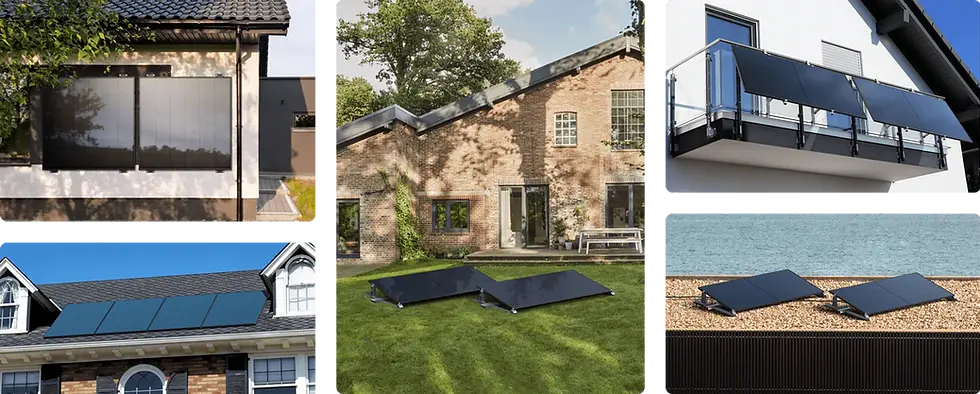
For most Wisconsin homes, the battery-backed version is the one worth considering. A bare microinverter only helps while the sun is up and the house is using the power right then. Add a battery and you can shift some of that energy to the evening and run a few critical devices straight off the unit. In a state without California-level electricity prices or a fragile grid, the honest use case isn’t “replace your utility.” It’s smaller and more useful than that:
Offset part of your daytime usage
Learn how your home consumes energy
Add a small amount of resilience
Participate in clean energy without a rooftop array
Keep the spend small enough that it doesn’t have to be perfect

Don’t buy a random kit: the safety part
This is where we have to be blunt.
A plug-in solar product is still a generation device. It sends power into your home’s wiring, which is nothing like plugging in a lamp. Poorly designed systems raise real questions about outlet ratings, backfed branch circuits, breaker behavior, emergency shutoff, insurance, and whether the thing was tested for the U.S. at all.
The specifics matter. UL now publishes UL 3700, a safety standard written specifically for plug-in solar devices, so a legitimate product can tell you it’s certified. Good systems also call for a dedicated circuit with nothing else on it. Share a circuit with other appliances and you can overload the wiring without ever tripping the breaker, because the breaker only sees the current flowing through it, not the power the panel is feeding in downstream.
A Wisconsin Distributed Resources Collaborative review flagged exactly these issues, plus the gap between European 240V systems and our 120V outlets. The rule of thumb: if a balcony kit can’t show you its UL listing in one click, don’t plug it into your house.
Does balcony solar work during a power outage?
Usually not the way people hope. Grid-tied inverters are designed to shut down when the grid goes down, a safety feature called anti-islanding that keeps a small system from energizing wires while utility crews are working. So a plug-in setup generally stops feeding the house the moment the lights go out.
If your unit includes a battery with its own outlets, you can power a handful of devices plugged directly into it (a fridge, a router, a phone, a CPAP), but that isn’t whole-home backup. If outage protection is the real goal, jump down to batteries, generators, and vehicle-to-home.
Is balcony solar legal in Wisconsin?
This is the messy part.
Wisconsin has a formal interconnection process for systems that run in parallel with the grid, and traditional rooftop solar goes through it with MGE, Alliant, We Energies, and the rest. Plug-in balcony solar sits in a newer category that state policy hasn’t caught up to.
A system configured so it never exports power tends to raise fewer utility questions. One that can export, even briefly, starts to look like a small interconnected generator, and being physically smaller doesn’t make that question disappear.
The category is developing quickly, and we expect clearer rules and better products over the next few years. We dig into the legal details in our companion guide, Balcony Solar Wisconsin: Is Plug-In Solar Legal and Does It Make Sense?.
Bottom line: balcony solar is the most promising option on this list and the least settled. Watch it, experiment carefully with U.S.-certified gear, and don’t treat it as a substitute for a code-compliant rooftop system or professionally installed battery backup.
Community Solar in Wisconsin: MGE Shared Solar vs. the Subscriptions You See Online
In Wisconsin, “community solar” almost always means your utility’s program, not the third-party subscriptions advertised in other states. The distinction matters, because the two work differently.
Utility community solar (the one that’s actually available here)
MGE’s Shared Solar lets eligible customers subscribe to shares of the 6-megawatt Strix Solar array in Fitchburg, which came online in 2025. You pay a one-time up-front fee and then a monthly per-kWh premium for up to half of your annual electricity use. The rate is locked for the six-year term, and you can take the subscription with you if you move within MGE’s territory. There’s also a low-income participation tier.
What you’re buying is cleaner grid energy, not a rooftop system. No panels, no maintenance, no outage protection, and possibly a small premium depending on the program. It fits if your goal is reducing your environmental footprint rather than maximizing savings or surviving a blackout.
Third-party subscription community solar (mostly elsewhere)
In states with community-solar laws and virtual net metering (Illinois, New York, Massachusetts, Maryland), companies like Arcadia and Perch match customers to solar farms and pass along bill credits tied to that project’s output.
Wisconsin has historically lacked that broad statewide framework, so those options are limited here. Lawmakers have floated bills to expand access, which makes this worth watching, but for now the practical answer is simple: start with what your own utility offers. In MGE territory, that’s Shared Solar.
Time-of-Use Rates: The Alternative With Nothing to Install
If the goal is a lower bill and you can move some usage to nights and weekends, you can save money without putting anything on your roof. For Madison residents, MGE and Alliant both offer a residential time-of-use rate where electricity costs more during peak demand and less off-peak.

Time of use rates available for Alliant customers 
Time of use rates available for MG&E Customers
If you can shift meaningful load into the cheap hours, you can save quite a bit
It’s a strong fit if you have flexibility to work with:
An electric vehicle you can charge overnight
A heat pump water heater
A dehumidifier you can schedule
Laundry and dishwasher loads you can move
A battery or smart-home controls
Time-of-use rates aren’t for everyone. If your household burns most of its power during weekday peaks and can’t shift it, you can end up paying more, so check your usage pattern before switching. But for flexible homes and EV owners, it’s the least exciting item on this list and often the highest return on zero dollars.
Batteries Without Rooftop Solar
A home battery doesn’t require solar. It can charge straight off the grid and keep your essentials running when the power’s out. On a time-of-use rate, it can also charge when power is cheap and discharge when it’s expensive, a trick called energy arbitrage.
Be honest about the economics, though. In MGE territory, the bill-savings case for a battery alone is still weak today. The backup value is the real draw, and it’s genuine for homes with:
Sump pumps or well pumps
Medical equipment
Freezers full of food
Home offices and critical internet
Frequent rural outages
A battery is cleaner, quieter, and more automatic than a portable generator, but it costs far more per hour of backup. The best candidates are homeowners who place a high value on silent, hands-off backup and want to be positioned for a future where time-of-use rates and utility virtual-power-plant programs become more common.
Vehicle-to-Home: Your Next Battery Might Be Parked in the Garage
If you drive an EV that supports bidirectional charging, you may already own the biggest battery on your block.
Some newer EVs can push energy back into the home, a setup called vehicle-to-home (V2H), and an EV pack is often several times the size of a wall-mounted home battery.
The catch is that V2H isn’t plug-and-play. It needs a compatible vehicle, the right bidirectional hardware, and proper transfer and islanding equipment, so it’s a real installation, not an extension cord. But if you’re planning to buy an EV in the next few years and you also care about backup power, this belongs on your radar now.
For some homes the future energy stack won’t be rooftop solar plus a battery at all. It’ll be a quality roof, a time-of-use rate, smart EV charging, V2H backup, and maybe a small solar or battery add-on later. That’s a different road to energy independence, and it still gets you there.
Generators: Still the Simple Answer for Outages
If your one real goal is keeping the lights on when the grid fails, a generator is still the most straightforward fix. A standby unit can automatically power selected circuits or the whole home, and a portable generator paired with a proper transfer switch can cover critical loads for much less money.
Generators aren’t clean energy. They burn fuel, they’re noisy, they need maintenance, and they should never run indoors or be wired in improperly. But for long-duration outages, they routinely beat batteries on both cost and runtime.
A generator is the right call if:
Your home sees frequent or long outages
You depend on a well pump or sump pump
You need heat, refrigeration, or medical equipment during an outage
You want resilience more than sustainability, and aren’t ready to spend for a large battery
One Madison-area reality check: MGE is one of the most reliable utilities in the country, and a lot of homes in its territory simply don’t rack up enough outage hours to justify expensive backup on the math alone.
But peace of mind is personal. If an outage would genuinely upend your household, the payback was never only about dollars.
Geothermal: The Bigger Carbon Move Most People Overlook
If the real goal is cutting your home’s carbon, geothermal often does more than rooftop solar would. Ground-source heat pumps use the stable temperature of the earth to heat and cool a home with high efficiency. In Wisconsin, where space heating eats a large share of annual energy use, getting off fossil-fuel heat moves the needle hard.
This isn’t a small project. Geothermal needs ground loops or wells, careful design, and coordination with your HVAC equipment, and it usually costs more upfront than a standard furnace-and-AC swap. For the right home, though, it’s one of the most meaningful electrification upgrades available.
If you’re exploring it locally, G.O. Loop Wisconsin is a regional resource for geothermal drilling and loop-field installation.
Geothermal makes the most sense if your furnace or AC is near end of life, you plan to stay long-term, your site can accommodate loops, and you’re motivated by sustainability more than a fast payback (especially when your roof isn’t a solar candidate anyway). Solar gets the attention because you can see it. Geothermal just quietly does the work.
Your Roof Still Matters, Even If Solar Doesn’t
If solar comes off the table, the roof doesn’t. It’s still a critical home system, protecting the structure, attic, wiring, insulation, belongings, and the people underneath it, while shaping ventilation, moisture control, resale value, and any future solar readiness.
If your roof is old, worn, leaking, or poorly ventilated, the smartest energy move may be a quality roof replacement, not solar. For most Wisconsin homes that means premium asphalt shingles installed by a contractor who actually understands ventilation, flashing, underlayment, and ice-and-water protection.
And despite the national marketing push, Wisconsin homes are not automatically metal-roof candidates.
Metal earns its place on barns, cabins, modern designs, and steep, simple roof planes. But for most residential roofs in Southern Wisconsin, high-quality asphalt is still the smarter, better-looking, more cost-effective default once you account for complex shapes, valleys and penetrations, snow and ice behavior, noise, repairability, and matching future repairs to the neighborhood. A great asphalt roof isn’t a compromise. It’s usually the right answer. We break down the tiers in our asphalt shingle comparison.
If your roof is newer, keep it that way. Regular roof inspections catch granule loss, flashing wear, sealant failure, nail pops, and storm or animal damage while they’re still cheap to fix. A well-maintained roof also keeps the door open if your solar situation changes later, since solar can add resale value only when it sits on a roof that’s ready for it. Even if you never install a panel, the roof is doing the most important job on the house.
Sometimes the Best Move Is “Not Yet”
Waiting is a legitimate strategy, even coming from a roofing and solar company. You may not need to do anything right now if your bills are already low, your roof is heavily shaded, you’re planning to move soon, you have higher-priority repairs, your utility already has strong clean-energy goals, you don’t have real outage concerns, or you’d rather see better plug-in solar rules first.
For a lot of homeowners, the smart sequence looks like this:
Replace or maintain the roof properly.
Improve attic ventilation and insulation.
Cut waste with efficient appliances and smart controls.
Try time-of-use rates if they fit your habits.
Watch balcony solar and battery tech as it matures.
Revisit full solar later if your roof, rates, or goals change.
Good energy decisions aren’t about buying the most exciting product. They’re about matching the solution to the house and the homeowner.
Match the Tool to the Goal: A Quick Decision Guide
If your goal is lower bills: start with time-of-use rates, efficiency upgrades, smarter EV charging, and possibly balcony or community solar.
If your goal is backup power: compare batteries, generators, and vehicle-to-home charging. Balcony solar alone won’t cover whole-home backup.
If your goal is sustainability: look at community solar, geothermal, broader electrification, and future rooftop solar if your roof changes.
If your goal is energy independence: think in layers: roof condition, panel capacity, batteries, EV charging, backup, and maybe plug-in solar.
If your roof is old: fix the roof first. Don’t put a 25-year array on a roof near the end of its life, and if solar isn’t right anyway, the replacement is the better investment.
Frequently Asked Questions
Is balcony solar legal in Wisconsin?
There’s no Wisconsin law that specifically authorizes plug-in solar yet. Traditional rooftop solar goes through the utility’s interconnection process. A balcony system set up so it never exports power raises fewer questions, while one that can export looks more like a small interconnected generator. Utah passed the first U.S. plug-in solar law in 2025 and 30-plus states have introduced their own, so expect Wisconsin’s rules to keep evolving.
Does plug-in solar work during a power outage?
Generally no. Grid-tied inverters use anti-islanding to shut down when the grid goes down, so the system stops feeding the house. If your unit has a built-in battery with its own outlets, you can run a few devices plugged directly into it, but that isn’t whole-home backup.
Can you save money with a battery and no solar?
On backup value, yes. On pure bill savings, rarely in MGE territory today, because the time-of-use price spread usually isn’t wide enough to pay back the battery on arbitrage alone. Buy a standalone battery primarily for quiet, automatic backup, not as a money-maker.
Is community solar available in Wisconsin?
Mostly through utility programs. MGE’s Shared Solar - Strix lets customers subscribe to shares of a Fitchburg solar array for up to half their annual usage. The third-party subscription model common in states like Illinois and New York isn’t broadly established in Wisconsin.
Should I replace my roof before adding solar?
If your roof is within roughly ten years of the end of its life, yes. Panels are designed to last 25-plus years, and pulling them to replace the roof underneath is expensive and avoidable. Sort out the roof first, then evaluate solar on a clean slate.
Final Thought
Rooftop solar is a great fit for some homes and a poor fit for others. Both are fine. A shaded lot, a complex roof, a low-usage profile, or an aging roof doesn’t mean you have no path forward. It means the right path may look different: balcony solar for one homeowner, community solar or a time-of-use rate for another, a battery, a generator, V2H, geothermal, or simply a better roof for the next. The best choice depends on what you were hoping solar would do for you in the first place.
If you’re not sure whether your roof is a good candidate for solar, or whether it should be replaced before you think about solar at all, Sun Vault Roofing can walk you through it straight (including the times when the honest answer is “not solar”).


