Tesla Solar Roof Discontinued: What It Means for Solar Shingles in Wisconsin

Is the Tesla Solar Roof discontinued, and what happens to existing owners?
Tesla Solar Roof discontinued in August 2026, according to Electrek. Electrek reported on August 20 that Tesla told its installers tiles are no longer available to order, and Tesla's Solar Roof page now redirects to its solar panels page. We found no formal Tesla announcement.
In Wisconsin, the integrated option you can actually buy is CertainTeed's solar shingle: Solstice now, and Landmark PWR, which Solar Power World reports becomes officially available November 1, 2026.
Solar shingles make about 16 watts per square foot of shingle. In 2026 the solar portion of a Solstice project has run about $3.50 to $4.50 per watt, on top of the cost of a conventional asphalt roof replacement.
Which solar shingles can you still buy in Wisconsin?
Solstice is available now through CertainTeed-credentialed roofing contractors, including Sun Vault Roofing. Apollo II was CertainTeed's first-generation solar shingle and is no longer installed, and Landmark PWR is the newest generation. CertainTeed backs both current shingles with 25-year limited power and workmanship warranties.
Two others come up:
GAF Timberline Solar: GAF has told us it is not currently offering its solar shingle in Wisconsin.
Kaneka: not available for U.S. residential installs.
Sun Vault Roofing has no first-hand experience installing Tesla or GAF products. For every brand side by side, see Solar Shingle Brands Compared.

How much power does a solar shingle make per square foot?
About 16 watts per square foot of shingle, compared with about 19 to 21 for a full-size panel. That is our math from CertainTeed's datasheets, using exposed shingle area, set against REC's datasheet for a full-size panel including its frame. For the same kilowatts, a shingle array needs roughly 1.2 to 1.3 times the roof area. The full table is in Solar Shingle Brands Compared.
How much do solar shingles cost per watt compared with panels?
We think of a solar roof as two parts: what a conventional asphalt replacement would cost, plus the extra cost of using solar shingles instead of asphalt where the solar goes. For 2026 projects we price that second part at $3.50 to $4.50 per watt. It sits on top of the roof, because a new roof is a prerequisite for solar shingles.
How we get the number: the price of the solar roof, minus the price of the same roof in asphalt shingles, divided by DC watts, with batteries and non-roof items stripped out. It covers 2026 projects only.
The low end: very large systems close to 20 kW, the cap for the utility's simplest connection category (Category 1). Our 18.55 kW Grafton installation sits near that limit.
Typical systems: around $4 to $4.50 per watt.
Panels: national residential installs of rack-mounted panels run about $2.60 to $3.50 per watt before incentives. EnergySage puts its marketplace average near $2.60, SEIA and Wood Mackenzie's benchmark is $3.36 as reported by Solar.com, and Intelligent Living (see below) cites $2.80 to $3.50.
So for the solar portion of the project, solar shingles cost under twice as much per watt as rack-mounted panels.
Do solar shingles cover less of the roof than panels do?
Not in any way that is unique to shingles. Setbacks, vents and roof planes limit where any solar goes. Our setbacks are smaller for Solstice: 1.3 feet at eaves, 1 foot at hips, rakes and valleys, and 1.5 feet at ridges and obstructions, against 1.5 feet all around for panels, so a shingle array can sometimes cover more of a roof. Setbacks also leave room for firefighter access, and you can walk across solar shingles and drag a hose over them, which you cannot do on panels. A solar shingle is also the roof around it, so you buy one product that does two jobs.
Shingles make less power per square foot than a full-size panel. The comparison that matters is roof plus panels, not panels alone.
Recent Solstice systems of ours include 8.19 kW in Delavan, 11.62 kW in Madison, 12.18 kW in Verona and 18.55 kW in Grafton. Our earlier projects in Sheboygan and Oconomowoc are in Sun Vault Roofing installs Wisconsin's first solar shingle roof.

Who installs solar shingles: a roofer or an electrician?
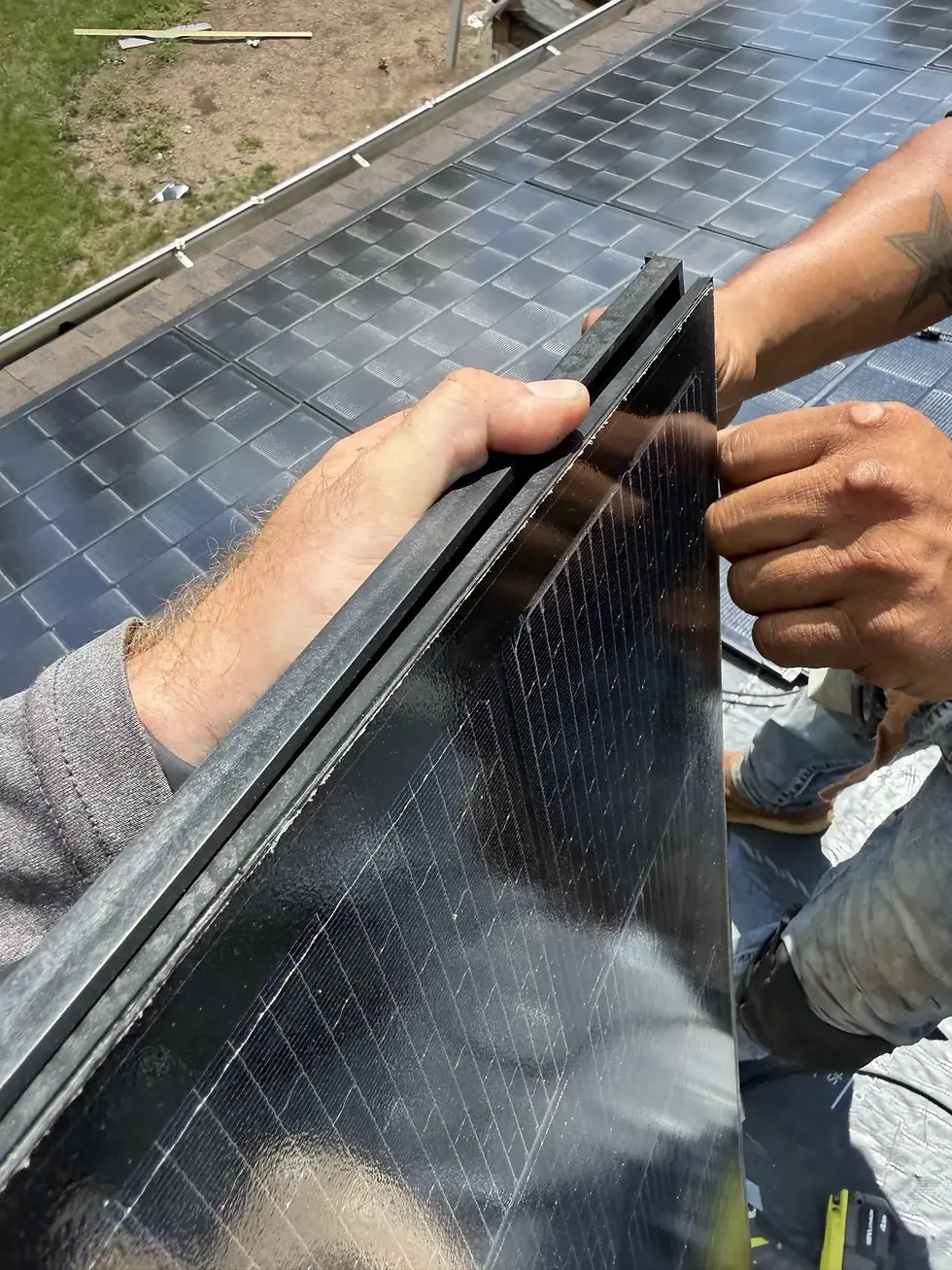
Both. A roofing crew installs the shingles. "A roofing crew can learn to install solar shingles quickly, because the method is the same as an asphalt shingle roof," says Mike Mannion, co-owner of Sun Vault Roofing. "The main differences are the shingle-to-shingle electrical connections, and using screws instead of a nail gun, which are simple to teach." A licensed electrician makes the connections from the attic to the inverter and handles inspection and utility interconnection, the same electrician role a rack-mounted system needs.
One wiring detail matters. Inside a building, solar DC wiring must run in metal conduit or metal-clad cable (cable with a built-in metal jacket). Outside, it can run as exposed sunlight-rated PV wire or in any conduit type. Rack-mounted systems in Wisconsin are wired on the exterior of the house, since attic wiring needs an electrician working in the attic, which costs more.
A shingle system drops its wiring into the attic, so that run is metal. That adds attic labor and metal conduit or cable. Solstice includes a rapid shutdown device, a firefighter safety feature that reduces voltage on the roof when activated. It sits near where the wiring enters the attic.

Does a solar shingle roof need holes through the roof?
Fasteners covered by the next course are not exposed, the same as nails on any asphalt roof. A rack system's attachments are exposed and need flashing and sealant, and a shingle roof has no exposed rack attachments through the roof surface. The wiring still passes through the roof deck at one opening sealed with flashing. You get one waterproofed product system and one party to call for a leak.
What does Intelligent Living's article get right, and where do we differ?
Aaron Jackson's October 12 article in Intelligent Living is a fair overview, and we agree with much of it.
Where we agree
Tesla quit, after roughly 3,000 U.S. installs.
Solar shingles make about 16 watts per square foot, versus roughly 20 for panels. Our datasheet math is close: about 16 per square foot of exposed shingle and 19 to 21 for a full-size panel.
The federal residential solar tax credit (called 25D) ended for systems installed after December 31, 2025, for shingles and panels alike.
Tightly mounted modules run hotter, which costs some output.
Where we read it differently
Cost per watt. The article puts shingles at $6.00 to $8.50 per "effective watt" without defining the term. Its figure for a 2,500 square foot roof, $52,500 to $62,500, is a whole-project price that includes the roof, and it compares that with about $31,000 for an asphalt re-roof plus an 8 kW panel array. If the shingle system were also 8 kW, that would be about $6.50 to $7.80 per watt of total project. Taking out the ordinary asphalt roof, our solar portion is the $3.50 to $4.50 above.
Three trades. The article counts a roofer, a solar installer and an electrician. With CertainTeed's shingle it is a roofing crew and a licensed electrician, and a rack system needs the electrician too.
Apollo II. The article lists it among systems sold in 2026. For CertainTeed it was the first generation and is no longer installed.
Repairs. The article calls repair harder. With Solstice it can be.
Can you repair or replace one solar shingle?
With Solstice, repairing one shingle can require removing the shingles upstream of it in its string (a run of shingles wired together in a line), and strings often run 50 or more shingles. Warranty, insurance or the installer's workmanship coverage pays the labor depending on cause. CertainTeed has told us roughly 0.02% of Solstice shingles have had issues, so in practice it is rare.
Landmark PWR is designed so an individual shingle can be popped out and replaced, by a trained installer. That is like replacing a panel, but easier, with no racking to unfasten.
What should you expect from Landmark PWR?
Landmark PWR is new, so ask any installer how many they have put in. It is rated for roofs with a pitch of 4/12 or steeper (4 inches of rise per 12 inches of run). Solstice's literature allows 2/12, but we would never put it on a 2/12 roof and CertainTeed prefers 4/12 or above, so in practice that is not a difference.
CertainTeed markets Landmark PWR as cost-comparable to a new roof with rack-mounted panels. We do not expect it to reach parity with rack-mounted panels, but we do expect it to be closer than Solstice and a bit cheaper; our full read is in Solar Shingle Brands Compared. We have not installed one yet, but we have weekly calls with CertainTeed, have discussed it with them at length for months, and have seen it installed on video, so our labor numbers are informed projections. We plan to begin installing it in spring 2027 if it is shipping by then.

When does a solar shingle roof make the most sense?
When you are building new or the roof is due anyway. The product is for new construction or re-roofing, not for going over an existing roof. The federal residential solar tax credit has ended, so new construction gets no credit advantage in 2026. The case for solar shingles is cost and integration, not credits.
Ask us whether Focus on Energy's rebate treats shingle systems and new construction the same as rack-mounted panels. Our 2026 incentives post has the details.

Solar shingle questions Wisconsin homeowners ask
Is the Tesla Solar Roof discontinued?
Reportedly yes. Electrek reported on August 20, 2026 that Tesla told its installers tiles are no longer available to order. We found no formal Tesla announcement. Existing roofs are reportedly still under warranty, per Electrek's September 1 follow-up.
Can I still buy solar shingles in Wisconsin?
Yes. CertainTeed's Solstice is available through credentialed roofing contractors, including Sun Vault Roofing. Landmark PWR is reported to become available November 1, 2026.
Do I need a roofer or an electrician for solar shingles?
Both. A roofing crew installs the shingles, and a licensed electrician makes the attic-to-inverter connections and handles inspection and utility interconnection.
Are there tax credits or rebates for solar shingles in Wisconsin?
The federal residential solar tax credit ended for systems installed after December 31, 2025. Focus on Energy's 2026 rebate for rack-mounted panels is $600 per kW up to $2,400, with applications due within 60 days of installation and by January 31, 2027. We are not certain it treats solar shingle and new-construction systems the same way, so ask us before you count on it.
Can I put solar shingles on my existing roof?
Not over it. Solar shingles replace the roofing, so they are for new construction or re-roofing, per CertainTeed's installation guide.
Want to know whether a solar shingle roof fits your home?
Request an inspection and we will walk through what fits your roof before you commit to a full replacement. You can also see solar shingle products at our Verona office, 115 Enterprise Dr, Verona, WI 53593.