
Prepare for a Roof Replacement: The Wisconsin Homeowner Guide

Updated: Aug 11
To prepare for roof construction day: mow the lawn, clear the driveway, park down the street, protect your interior belongings, and plan around the noise. Get those right and your contractor should take care of the rest.
That's the short version. Below is the complete list, organized so the items that apply to every homeowner come first and the ones that only apply to some situations come later. Wondering what happens once the crew arrives: tear-off, underlayment, shingles, cleanup? We cover that step by step separately. This guide covers getting ready for it.
Note: this is a longer and more detailed treatment of this topic. If you are a Sun Vault Roofing customer and your project is scheduled for the coming days, you can start with the shorter version of the checklist here.

Key Takeaways: How to Prepare for a Roof Replacement
Mow your lawn
Plan around the noise: pets, work-from-home schedules, and neighbors.
Clear the driveway
Park down the street (not in the driveway or in front of the house)
Secure fragile wall-hung items
Protect belongings in attics or detached garages
Confirm plans for roof- or soffit-mounted security cameras, satellite dishes, or solar panels
Understand special requirements for insurance-funded reroofs
Anticipate landscaping impact
The Non-Negotiables: What Every Homeowner Should Do
Every homeowner preparing for a roof replacement should start here, regardless of home size, roof type, or contractor.
Mow your lawn. We regularly 10-20 thousand nails when we install a new residential roof. That means there are 10-20 thousand nails coming out of your old roof. We catch the majority of them in the dump trailer or on protective tarps, but some do inevitably end up in the grass. To pick these up, we use a magnetic rolling magnet. The performance of that magnet degrades exponentially as the grass gets taller.
Park down the street, not out of the driveway. A car parked on the street directly in front of the house can still sit in the debris zone or block the spot needed for a dump trailer or construction vehicle. Crews need the full driveway: for material staging, for the trailer, and often for a second or third truck. Move vehicles past the property line for the duration of the project, not off to the side.
Take down anything fragile hanging on interior walls. Tear-off and nail guns send vibration through the whole structure, not only the roof. Mirrors, framed art, china cabinet contents: walk your walls and shelves to secure your valuables.
Cover anything stored in the attic. Dust and small debris will work through gaps in the roof decking during tear-off. If skylights are being removed or large amounts of plywood decking need to be replaced, some debris falling inside is inevitable. If all you have in there is insulation, there's nothing to worry about. But if you store belongings, you'll want to protect them somehow. Old sheets or plastic sheeting work fine. On one Verona-area job, a homeowner with a finished third-floor attic space realized the morning of his project that he'd forgotten to tarp his belongings, and he was already out of town. He called, gave us access, and we handled it before starting.
Protect anything in your detached garage. If your detached garage roof is part of the project, treat it the same way. Garage decking gets the same tear-off and nailing the house roof does, and most garages don't have the sealed, insulated ceiling a living space has, so dust and debris come through just as easily. Move vehicles out for the day, and cover anything you don't want dusty. If the garage isn't part of the scope, none of this applies.
Plan around the noise. Tear-off and shingle installation are loud: air compressors, nail guns, a crew moving material across the deck. It's loudest upstairs and outside; a basement office usually has enough distance to stay functional. If you or your pets are sensitive to it, plan to be elsewhere for the day. A quick heads-up to your immediate neighbors goes a long way too, since a crew, a trailer, and a materials drop are hard to miss.
Expect some landscaping impact, and ask your contractor to be specific about where. Roofing is a major exterior construction project. A competent roofer will take steps to protect your landscaping by using protective tarping, but on some properties, a non-zero degree of landscaping impact is inevitable. A flower bed under a section of steep roof or a strip of lawn under the trailer's path can get damaged. A trustworthy and thoughtful contractor will be transparent about these types of impacts in advance.

Confirm these at least One Week before your new Roof Installation
The following applies to nearly every homeowner too, but on a longer timeline. Lock these in during the week or two before your project, not the night before.
Confirm your contractor's material delivery plan. Materials typically arrive either the night before or the morning of install day. Know which, so a 6 am driveway delivery doesn't trap your vehicle in the garage.
Walk the property with your contractor beforehand, if you haven't already. Point out sprinkler heads, delicate landscaping, and anything else worth flagging. A two-minute walk-through prevents most surprises.
If you're in an HOA, make sure any required approval is already finalized in writing. This should be settled as part of scheduling. If it isn't, confirm it before your install date locks in. Some HOAs may have specific requirements: read our guide about selecting shingle color in Wisconsin for help navigating those.
Should You Schedule Your Roof Replacement While You're Out of Town?
A fair number of homeowners plan their roof replacement around a trip they're already taking. It's not a bad instinct: you skip the noise entirely, and if your car stays in the garage for the duration, nobody needs to move it in or out.
The catch: anything you'll need access to has to move before you leave, not while you're gone. We had a gutter replacement in Waunakee where the homeowner was out of town and a 30-year-old camper van got left in the driveway. Tearing out three decades of old gutters is messy work, and some of that grime ended up on the van. It cleaned off fine, but it didn't need to happen.
If you're planning to be away, walk through what's parked where and move anything you'd rather not expose to a construction zone for a few days, before you leave.
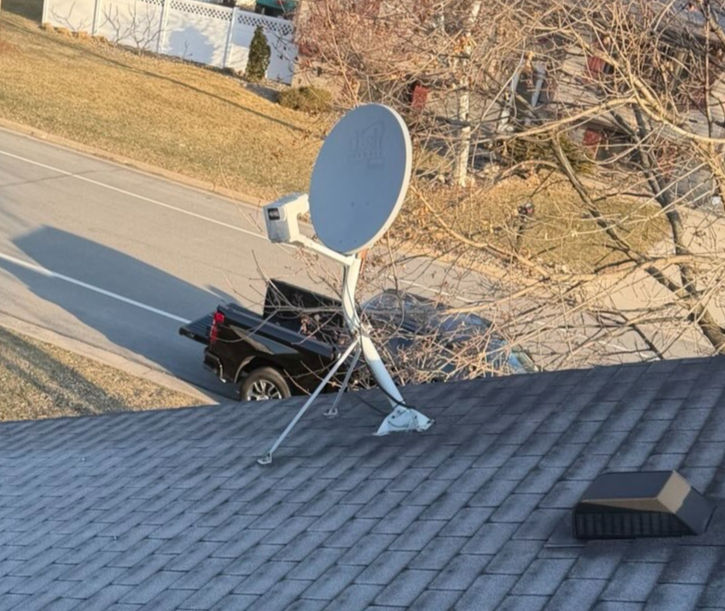
What If You Have a Security Camera, Satellite Dish, or Solar on Your Roofline?
Anything mounted to your roof or soffit needs a plan before tear-off starts, not during it.
How to prepare your security system for a roof replacement
Soffit-mounted security cameras can usually be removed by your roofing crew, but remounting is a separate job. Coordinate with your camera company in advance or plan to do this yourself.
Preparing your Satellite Dishes for a roof replacement
Satellite dishes work similarly: most crews will remove one as part of the job, but reinstallation is on you if you still use it. If it's been sitting unused, this is a reasonable time to leave it off. For the full explanation of how a dish left in place can damage a roof over time, see our guide to satellite dish removal.
Preparing your Solar panels for a roof replacement
Conventional rooftop solar panel systems take longer to plan around. Removal and reinstallation of solar panels complicate the overall timeline, as we recommend that this work be completed by the original solar installer. Installers don't make profit from these types of jobs, so scheduling is not always a priority.
Your roofing contractor may be qualified to help with this type of work, if they have in-house solar expertise, but there is risk inherent with that strategy as it may void your solar installer's workmanship warranty.
A roof replacement is the ideal time to upgrade your solar system
If your solar system is already more than 5-10 years old, your roof replacement is the perfect time to consider an upgrade. Solar panel technology has advanced considerably in the past 5-10 years, and your old panels are possibly producing at only 85-90% of their original efficiency.
Consider upgrading to new solar panels or even consider an upgrade to a fully-integrated solar roof.

Preparing for an Insurance-Funded Reroof
If your project is a storm-damage insurance claim rather than a standard replacement, nearly all of the physical prep above still applies exactly the same way. What changes is mostly paperwork on the contractor's side: documentation, adjuster coordination, and claim-specific scheduling, not what you personally need to do around the house. For the full breakdown of how an insurance-funded roof replacement differs, see our storm damage insurance guide.
What If You're on a Well or Septic System?
This one's easy to miss and rarely shows up in generic roofing checklists. A loaded dump trailer and multiple trucks put real weight on a driveway or yard, enough to matter if a septic field or well components run underneath the area a contractor plans to use. If your property is on well or septic service, more common outside Dane County on rural properties, flag it before install week so equipment can be positioned away from it.
Scheduling a Roof Replacement Around Other Trades
If your project includes work beyond roofing (gutters, siding, soffit and fascia, exterior painting), avoid scheduling more than one exterior trade on your property the same week unless your roofing contractor is coordinating all of it directly. Overlapping crews from different companies competing for the same driveway and staging space is a common, avoidable source of delay.
What Happens If the Weather Doesn't Cooperate?
Prep for a possible delay the same way you'd prep for the project itself: don't schedule anything irreversible (movers, other trades, a big outdoor event) right around your install date. A reputable contractor won't leave a roof exposed if rain is likely, and will postpone rather than risk it. That means your actual start date can shift by a day or more even after you've done everything right on your end.

The Preparation a Roofing Contractor Should Already Be Handling
Part of preparing for a roof replacement is knowing what's already covered, so you're not duplicating effort. A detail-oriented crew tarps landscaping, walkways, the driveway, AC condensers, and the patio before tear-off starts. A dump trailer parked as close to the house as the driveway allows catches most debris directly instead of letting it scatter across the yard. Cleanup should include an actual magnetic sweep for stray nails, not a visual check.
None of this is something you need to do yourself, but it's worth asking any contractor you're vetting whether they do it, specifically. A vague answer is worth noting.
When This Roof Replacement Checklist Doesn't Apply
Everything above assumes a standard residential re-roof in reasonable weather. A few things change the shape of it. Steep or multi-story roofs take longer to tarp and stage safely, which can extend prep time on the crew's side. Homes with multiple existing shingle layers, common in older neighborhoods around Middleton and Fitchburg, often mean more tear-off time and a higher chance of a decking surprise once the old layers are off. Any project bundling in solar, gutters, or other trades the same week needs its own coordination plan, not the standard one.
Quick-Reference Checklist
For the short version (the one we send every customer a few days before their own project), below is the condensed list:
Mow your lawn
Park down the street
Secure or remove fragile wall-hung items
Cover anything stored in the attic
Plan around the noise for you, pets, and neighbors
Move lawn furniture, grills, trash cans, and potted plants (or let the crew help)
If you'll be away: move what you need first, and loop in your project manager
Confirm any camera, satellite dish, or solar coordination in advance
Flag a well or septic system if you have one
What happens during a Roof Replacement?
So far, we've just covered preparation. Curious what happens once your crew arrives and construction begins? Check out our full roof replacement process guide.
Frequently Asked Questions
Do I need to be home during my roof replacement?
No. Many homeowners aren't. If you'll be away, let your contractor know in advance so they can coordinate access for anything you'd normally handle yourself, like attic tarping.
Will my landscaping be protected during a roof replacement?
A detail-oriented crew tarps landscaping, walkways, the driveway, and the patio before starting. On tight properties, some risk to plants directly under the work area is close to unavoidable, and a straightforward contractor will flag those spots before beginning, not after.
What should I do with a satellite dish or security camera before a roof replacement?
Confirm removal with your roofing contractor and reinstallation with the camera or satellite company in advance, not the morning of. See our full guide to satellite dish removal for more detail.
Does an insurance-funded roof replacement require different homeowner prep?
No, the physical prep is the same. The difference is paperwork and documentation on the contractor's side. Read more in our storm damage insurance guide.
How much does a roof replacement cost?
That's a separate question from preparation. See real project pricing and our instant estimate tool for current numbers.


