
Why You Should Get a Roof Inspection When Buying or Selling a Home

Updated: 3 days ago
"The height and pitch of the roof do not allow for walking on the roof surface. This may limit the inspector’s ability to accurately assess roof condition."
When I purchased my home, I was shocked to read this asterisk buried at the bottom of the inspection report in small font. I had just paid $400 for a professional real estate inspection, and it seemed like they skipped over one of the most important and issue-prone systems in the home.
Not all roof problems shout. Many whisper.
And often they don’t reveal themselves with a simple visible check from the ground, ladder, or a drone. This is not meant to be a dig at home inspectors. They must cover the entire property in a few hours. But that’s exactly why a general home inspection and a professional roof inspection are two different services. And before buying or selling a property, you need both.
Why You Should Get a Roof Inspection When Buying or Selling a Home: Key Takeaways
A home inspection gives the roof limited attention. A professional roof inspection is a separate, focused service that provides the details buyers and sellers actually need.
The roof is one of the most expensive systems in a home to replace, and its condition affects your budget, insurance options, and negotiating position before closing.
Finding roof problems during the inspection contingency period gives buyers real options: repairs, credits, or price adjustments. After closing, those options are gone.
Sellers who inspect before listing avoid surprises, build buyer confidence, and go into negotiations with documentation rather than uncertainty.
A transferable warranty is a real asset. Before closing, confirm who installed the roof, whether an active workmanship warranty exists, and what’s needed to transfer coverage.
If you’re not sure what a professional roof inspection involves, it’s worth understanding the process before you’re under contract. For buyers and sellers, knowing the difference can save thousands of dollars.
Why a Generic Home Inspection Isn't Enough for Your Roof

Home inspectors evaluate plumbing, electrical, HVAC, foundation, and roofing systems in a single visit, usually within two to four hours. The roof gets a small section in a 100+ page report, but rarely a thorough evaluation, and here's why that matters more than most buyers and sellers realize:
The scope is too broad for the depth a roof requires. A general home inspector is trained to spot obvious red flags across dozens of systems, not to diagnose the specific failure points of a roofing assembly. Shingles, flashing, decking, ventilation, and sealant condition each require specialized knowledge to evaluate correctly. Spreading that expertise across an entire house means the roof gets a fraction of the attention it needs.
Access is often limited by design, not choice. Wisconsin home inspection requirements don't require inspectors to walk the roof. Many don't carry insurance for it, and liability concerns keep them on the ground or a ladder at the eaves.
So reports often note:
"Ladder at eaves"
"Ground observation only"
"Roof not walked. Limited by: Height"
These are honest disclosures. But they also mean a major component of the home, one that can cost $15,000–$30,000+ to replace, wasn't fully evaluated.
The findings are too vague to act on. Home inspection reports typically use broad checkboxes like Satisfactory, Unsatisfactory, or Replace. That language doesn't tell a buyer whether they're looking at two years of remaining life or fifteen, and it doesn't give a seller anything specific to fix before problems become negotiation points.
Time pressure limits the level of detail. With an entire property to cover in a single visit, a home inspector simply doesn't have the time to trace a flashing detail at every penetration or check attic decking in multiple locations. Problems that require a closer, slower look get missed, not from negligence, but from the format of the service itself.
Why a Professional Roof Inspection Is the Best Option
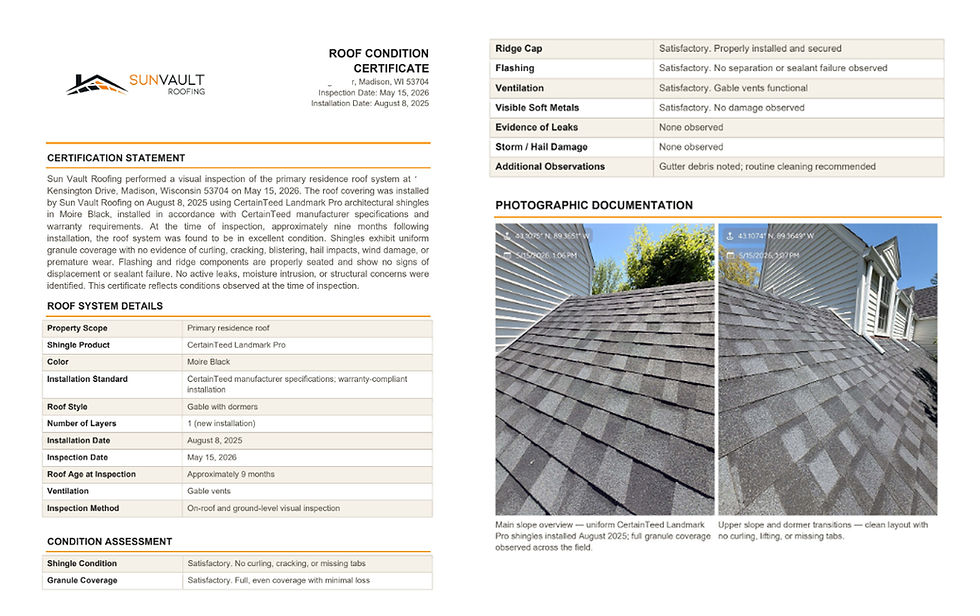
A professional roof inspection exists specifically to fill the gap a general home inspection leaves behind. Here's why it's the better option when real money and real decisions are on the line:
It's the entire focus of the visit, not a footnote. Where a home inspector spends minutes on the roof, a professional roof inspector spends the full visit there, typically one to two hours, evaluating shingles, flashing, decking, ventilation, and penetrations individually rather than as a single line item.
It includes physical, on-roof access. A licensed roofing professional is equipped and insured to walk the surface. That means they can feel soft spots underfoot, check whether shingle tabs are properly sealed, and visually confirm flashing conditions up close, none of which is reliably possible from a ladder or a pole camera.
It produces specific, decision-useful findings. Instead of a checkbox, a professional roof inspection report identifies the type of deficiency, its location, its likely cause, and an estimated remaining service life, for example, "Estimated remaining roof service life: approximately 2–5 years." That level of detail is what actually supports a repair request, a credit negotiation, or a replacement decision.
It's backed by trade-specific expertise. A roofing professional has seen thousands of roofs and knows what a failing flashing detail, a delaminating deck, or a compromised seal looks like at every stage of deterioration. That pattern recognition, built from specialization rather than general contracting knowledge, is what catches problems before they become expensive.
It documents the roof the way lenders, insurers, and agents expect. Because the report is roof-specific and detailed, it holds up better in negotiations and insurance conversations than a general inspection note ever could.
In short: a home inspection tells you a roof exists and looks generally okay from a distance. A professional roof inspection tells you exactly what condition it's in, what's wrong, and what it will cost to fix, information that actually changes how you buy, sell, or negotiate.
Why the Roof Matters More During a Home Purchase
Of all the systems in a home, the roof is one of the most expensive to repair or replace, and one of the least visible during a typical showing. That combination makes it worth paying close attention to during the home-buying process.
Budgeting after closing. If the roof has five years of life left and you weren’t expecting that, you’re facing a significant capital expense sooner than planned. Knowing the roof’s condition before closing lets you plan or renegotiate.
Homeowners insurance considerations. Many insurers ask about roof age and condition when issuing or renewing a policy. An older roof, or one with existing damage, can affect your coverage options, your premiums, or both. Some insurers may require a roof inspection before binding coverage on older homes.
Negotiation leverage. Roof condition is one of the most common points of negotiation in real estate transactions. A documented professional roof inspection gives buyers concrete information, including estimated remaining life, specific deficiencies, and repair scope, that supports a credit request or price adjustment far better than a general home inspection finding.
Unexpected repair costs. Roof problems don’t always announce themselves right away. A small flashing failure or deteriorating sealant can go unnoticed for months and then cause significant interior damage. Identifying these issues during the inspection contingency period, before you own the home, gives you options.
Home Inspection vs. Roof Inspection: What’s the Difference?
General Home Inspection | Professional Roof Inspection | |
Access | Ground-level or ladder at the eaves only; rarely walked due to liability and time constraints | Physical, on-roof evaluation combined with ground-level and attic-side review |
Time spent on the roof | A few minutes within a 2–4 hour whole-house visit | A full 1–2 hour visit dedicated entirely to the roof |
Scope | Roofing is one of dozens of systems reviewed (plumbing, electrical, HVAC, foundation, etc.) | Roofing is the sole focus; every component is assessed individually |
Shingle detail | General visual condition only; sealed tabs and lifted edges often can't be confirmed from a ladder | Confirms tab sealing, identifies lifted or curling shingles, and checks granule loss up close |
Flashing evaluation | Frequently noted as "Not all visible"; chimney, wall, and penetration flashing often unchecked | Each flashing point (chimney, step flashing, wall transitions, pipe penetrations) evaluated individually |
Decking and attic condition | Rarely assessed beyond a quick visual from inside the attic access, if accessed at all | Checked for soft spots, delamination, spacing issues, and signs of water intrusion |
Reporting language | Checkbox ratings: Satisfactory, Unsatisfactory, Replace | Descriptive findings with cause, location, and severity of each issue |
Remaining roof life estimate | Not typically provided | Specific estimate provided (e.g., "2–5 years remaining service life") |
Insurance and warranty relevance | Rarely addresses insurance implications or warranty status | Can flag insurance-relevant conditions (storm/hail damage) and warranty-relevant details |
Usefulness for negotiation | General flag at best; lacks the specificity needed to justify a credit or repair request | Provides documentation detailed enough to support repair requests, credits, or price adjustments |
Insurance/liability coverage for on-roof work | Many inspectors are not insured to walk the roof, limiting what they're willing to assess | Roofing professionals carry insurance specific to on-roof evaluation |
In a home inspection, the roof is often a footnote, through no fault of the inspector, given what they’re asked and insured to cover. In a professional roof inspection, it’s the whole document.
What a Professional Roof Inspection Catches That a Camera Misses
Some inspectors use pole cameras or zoom lenses when they can't walk on a roof. These tools help, but they can't:
Confirm that the shingles are properly sealed at the tabs
Detect soft or rotting decking beneath the surface
Identify lifted tabs or subtle installation defects
A professional roofer walking the surface can feel soft spots, check the condition of the sealant, and spot problems that simply don't show up on a camera feed.
Generic Home Inspection (The Inspection Center) | Sun Vault Roofing Roof Inspection |
Roof Inspection Method: Pole Camera | Roof Inspection Method: On-roof and ground-level visual inspection |

Same assignment. Completely different vantage point.
A pole camera or zoom lens sees the top surface of the shingle. It can’t:
Test whether shingle tabs are properly sealed at the factory strip
Detect soft or spongy decking beneath the surface
Identify lifted tabs or subtle installation defects
Examine pipe boots, flashing laps, or unsealed penetrations up close
A professional roofer walking the surface can feel soft spots, check the condition of the sealant, and spot problems that simply don’t show up on a camera feed.
Roof Inspections Cover More Than Shingles
Shingles are visible. But most roof failures start elsewhere.

Bad gutters: Gutters rarely get more than a passing glance in a general home inspection, often reduced to a note like "gutter debris observed" or "cleaning recommended." But clogged, sagging, or improperly pitched gutters can quietly damage a roof long before the gutters themselves look like the problem.
Standing water from a clogged gutter can back up under the shingles at the eaves, leading to rot in the fascia, soffit, and roof decking. Gutters pulling away from the roofline can signal fastener failure or water damage in the wood behind them, issues that don't show up from a ground-level walk-through. A professional roof inspection evaluates gutters as part of the roofing system itself, not as a separate item, checking for backed-up water damage, improper pitch, and attachment issues that a generic inspection typically overlooks.
A professional roof inspection also evaluates moss and algae growth, which is something a general inspection rarely flags beyond a cosmetic note. Left unchecked, moss growth accelerates shingle deterioration and can signal persistent moisture retention on the roof surface.

Flashing: the metal at chimneys, step flashing, wall transitions, and pipe penetrations is where many roof leaks begin. A home inspection may note “Flashing: Not all visible” — a single line covering an entire category. A professional roof inspection breaks down flashing into chimney, vent-pipe, and wall and step flashing, each assessed separately, with a specific condition noted for each. That matters because each flashing type fails differently, and each requires a different repair.

Decking and attic: Moisture problems often appear on the attic side before homeowners see them from inside.
A professional roof inspection checks for soft decking, delamination, spacing issues, and signs of water intrusion. A general home inspector's attic visit is usually a brief walk-through focused on insulation levels and visible framing, not a targeted search for roof-related moisture damage.
A professional roof inspector, by contrast, knows exactly where decking problems tend to originate, near flashing points, valleys, and penetrations, and checks those specific areas from the attic side as well as the roof surface. That targeted approach is why a roof inspection can catch early-stage decking issues that a general inspection, moving through the whole house on a fixed schedule, is likely to pass over.

Catching an interior leak: An active or developing leak is one of the clearest examples of why a professional roof inspection catches what a pole camera and a generic home inspection miss.
A pole camera or zoom lens can only capture what's visible on the surface from a distance. It can confirm that shingles are present and roughly intact, but it can't see beneath them, and it certainly can't see into the attic. A slow leak at a flashing seam or a compromised penetration can be actively feeding moisture into the decking for months while the roof still looks fine from the ground.
A general home inspector faces the same limitation from a different angle.
Their attic visit, if one happens at all, is typically a quick walk-through focused on insulation and visible framing. They aren't trained to trace a stain back to its source on the roof, and they aren't climbing onto the roof to confirm what's causing it. The result is often a report that notes a stain or discoloration without ever identifying the actual point of entry.
A professional roof inspector approaches it from both directions at once. On the roof, they can trace flashing, sealant, and penetration points for the specific conditions that produce leaks, cracked sealant, lifted step flashing, a nail pop, a failed pipe boot, even before any water has made it inside. In the attic, they know what active or historical moisture intrusion looks like on the underside of the decking and rafters: dark staining, soft or sagging wood, mold or mildew growth, and rusted fasteners, all signs that are easy to miss without knowing exactly where and how to look.
Buyers Need Remaining Roof Life, Not Just “Satisfactory”
Home inspection reports use checkboxes: Satisfactory, Unsatisfactory, Replace. They contain very little specificity about the roof.
What buyers actually need to know during the home-buying process:
How many years of life does this roof have left?
Is it a replacement in 2 years or 15?
Should I negotiate a repair credit before closing?
Assessment Type | What You Get | What You Can Do With It |
Standard home inspection checkbox | "Satisfactory" | Tells you nothing about timeline or cost |
Engaged home inspector binary | "Should be replaced" | No timeline, no scope, no repair vs. replace context |
Professional roof inspection (quantified) | "Estimated remaining roof service life: approximately 3–7 years" | Tells you whether you’re negotiating now or planning later |
A professional roof inspection answers those questions directly, for example: "Estimated remaining roof service life: approximately 2-5 years." That information changes how you negotiate, what you offer, and whether the home makes financial sense. If the inspection reveals the roof is nearing the end of its useful life, it's also worth understanding when repair is still a viable option versus when full replacement makes more sense.
Professional Findings Are Located, Not Global
Generic inspection reports describe roof conditions in broad terms. One standard Wisconsin inspection notes that the shingles "curled along the edges throughout the roof," with tabs missing "on the front and rear sides." That tells you something is wrong. It doesn’t tell you which slope, which penetration, or what scope of repair is actually needed.
A professional roof inspection gives you located findings: which run of step flashing is separating, which vent pipe boot is cracked, which face has the lifted tabs. That specificity is what makes the report actionable for estimating repair cost, structuring a negotiation credit, or deciding whether targeted repairs or full replacement is the right conversation.
This is one of the clearest reasons the roof is a footnote in a home inspection and the entire document in a professional roof inspection.
What Happens If You Discover Roof Problems After Closing?
Once the sale closes, roof issues become the new homeowner’s responsibility. That’s the reality of most real estate transactions, and it’s one of the strongest reasons to invest in a roof inspection when buying a house, specifically during the inspection contingency period, while you still have options.
Discovering a roof problem before closing gives buyers meaningful choices:
Request repairs. If the seller is motivated, they may agree to have specific issues corrected before closing. This is most practical for discrete problems, such as a failed flashing or a section of lifted shingles, rather than a roof that’s near the end of its service life. A roof repair and maintenance service can assess whether targeted repairs are appropriate or whether the scope points toward replacement.
Negotiate a credit. Rather than requiring the seller to manage repairs, buyers can request a closing credit or price reduction to cover anticipated costs. A professional roof inspection report with specific findings and scope supports this conversation with documentation rather than guesswork. If you do end up moving forward with a replacement, it helps to know what the replacement process looks like from start to finish so there are no surprises.
Adjust your expectations. Sometimes the roof condition is known, priced into the sale, and still acceptable to the buyer. What matters is making that decision with complete information, not discovering a problem six months after moving in.
The goal isn’t to alarm buyers. It’s to give them the information they need to make a confident, informed decision.
Our customer Tom purchased a beautiful home in Monona in March 2026. Two days after he moved in, a profuse leak started in the middle of his living room and damaged about $2,000 worth of interior carpentry. The problem? A portion of his chimney flashing, not visible from the ground or a ladder, was missing entirely. The home inspector couldn’t see it. A professional roof inspector would have spotted the problem in minutes.
Sellers: Get a Roof Inspection Before You List
A roof inspection before listing gives sellers a real advantage:
Avoid late-stage surprises. A roof issue discovered during a buyer’s inspection can delay closing or hand buyers negotiating power. Getting ahead of it means you control the outcome. It’s also worth noting that buyers are increasingly aware of common roofing contractor red flags and pricing tactics, so having documentation from a credible professional inspection strengthens your position.
Build buyer confidence. A documented inspection report tells buyers exactly what they’re getting and removes one of the biggest unknowns from the transaction.
Create a selling feature. A well-maintained, documented roof signals a cared-for home. In a competitive market, that matters.
Check Your Roof Warranty Before Listing
A professional roofer can identify the roofing material by manufacturer and product line, confirm whether an active warranty exists, and tell you exactly what’s needed to transfer it. A general home inspector typically cannot do any of those three things.
At the point of sale, that’s a meaningful gap because a transferable warranty isn’t just documentation; it’s protection the buyer is inheriting.
Before you sell or finalize a purchase, it’s worth taking the time to understand what warranty coverage exists and whether it transfers to the new owner. Having a transferable warranty is a major upside to a listing that should not be omitted.
Most roofing systems carry two types of warranties:
Manufacturer’s warranty: covers material defects
Workmanship warranty: covers the quality of the installation
Both may be transferable, but the process isn’t always automatic. Here are the key questions buyers and sellers should be asking:
Who installed the roof? A warranty is only as useful as the contractor who stands behind it. Knowing the installer helps verify coverage and reach them if something goes wrong.
Who is the manufacturer? Warranty coverage and transferability depend on the manufacturer and the product line.
Is there still an active workmanship warranty? Standard workmanship warranties vary in length. Some contractors offer extended workmanship coverage, so ask specifically whether that’s in place.
Is the warranty transferable? Many manufacturer warranties can transfer to a new owner, but they may require a formal transfer process, a fee, or notification within a specific window after closing.
What documentation is needed? Transfer requests typically require proof of the original installation, the product warranty certificate, and sometimes payment of a fee directly to the manufacturer. Having this paperwork organized before closing makes the process smoother for everyone.
A transferable warranty is a genuine asset in a real estate transaction. Buyers aren’t just purchasing the house; they’re purchasing the remaining protection on the roof.
For a deeper look at what warranty language actually means and what to watch for, see our guide: How to Read a Roofing Warranty: What Contractors Don’t Always Explain.
Questions to Ask During a Roof Inspection
Whether you’re buying or selling, a professional roof inspection is most useful when it gives you specific, actionable answers. Here’s a practical checklist of what to ask:
What is the estimated remaining service life of the roof?
Are there any current signs of leaks, water intrusion, or staining?
Are flashing areas at the chimney, walls, and penetrations properly installed and sealed?
Is there any evidence of decking damage, soft spots, or delamination?
Has the roof been repaired before, and if so, where?
Are there any areas of concern that could affect homeowners’ insurance coverage? (If the roof has sustained storm or hail damage, this is especially important to document.)
What is the roofing material, manufacturer, and product line, and is the warranty still active and transferable?
Is the existing warranty transferable, and what steps are needed to transfer it?
Buyers should ask these questions during the inspection contingency period, when the answers can still influence the transaction. Sellers benefit from knowing the answers before listing, so there are no surprises once offers come in.
How Much Does a Roof Inspection Cost?
At Sun Vault Roofing, real estate roof inspections start at $199.
That cost reflects a different level of documentation and formality than our free roof inspections. Free inspections are generally intended for homeowners who are monitoring their roof's condition, trying to determine whether a repair is needed, or seeking a roof replacement estimate.
A real estate roof inspection is more formal. It is designed to help a buyer, seller, agent, or lender understand the roof’s condition during a real estate transaction, when the findings may affect negotiations, credits, timing, or closing decisions.
The starting price may vary depending on distance, roof size, roof pitch, access, complexity, documentation needs, and other factors. Homes with solar panels, multiple roof sections, steep slopes, limited access, or special reporting requirements may cost more because they require additional time and care to evaluate properly.
If the inspection leads to a roof replacement project with Sun Vault Roofing within six months, we credit the inspection cost toward that service.
In other words, the inspection fee is not just a charge for looking at the roof. It is an investment in better information at a point in the transaction when better information can protect you from expensive surprises.
When to Schedule a Roof Inspection
If you are buying a home, get a roof inspection:
During the inspection contingency period, before negotiations close
If the roof is older or nearing the end of its service life
If the home inspection noted limited access or used a pole camera
If you are selling a home, get a roof inspection:
Before listing, so that you can address issues proactively
Before accepting offers, if the roof condition is likely to come up
How Can Sun Vault Roofing Help?

A general home inspection is essential, but it’s not a substitute for a professional roof inspection. Buyers and sellers who skip it are making one of the largest financial decisions of their lives with incomplete information about one of the home’s most expensive components.
Schedule a roof inspection with Sun Vault Roofing before buying or selling, and go into closing knowing exactly what you’re working with. Request your inspection here.
For more on warranty coverage, read our guide: How to Read a Roofing Warranty: What Contractors Don’t Always Explain.
Roof Inspection When Buying or Selling a Home: FAQ
1. Do I need a roof inspection if I’m already getting a home inspection?
Yes. A home inspection covers the entire property in a few hours and often evaluates the roof only from the ground. A professional roof inspection is a separate service focused entirely on the roof, providing condition details and a remaining life estimate that a general inspection typically can’t.
2. How long does a professional roof inspection take?
Most professional roof inspections take between one and two hours, depending on the roof’s size and complexity. You’ll receive a written report documenting the condition, deficiencies, and estimated remaining service life.
3. Who pays for the roof inspection, the buyer or the seller?
Either party can commission one, and both benefit from doing so. Buyers typically pay for their own inspection during the contingency period. Sellers who inspect before listing pay out of pocket but often recoup that investment through stronger negotiating positions and fewer closing surprises.
4. What if the home inspection already flagged a roof concern?
That’s precisely when a professional roof inspection is most valuable. A home inspection flag tells you something may be wrong. A professional roof inspection tells you what it is, how serious it is, and what it will cost to address.
5. Can a roof pass a home inspection and still need significant work?
Yes. Home inspectors can only evaluate what they can see, and many inspections are conducted from the ground or a ladder at the eaves. A roof can receive a satisfactory rating and still have flashing failures, soft decking, or limited remaining life that only a professional on-roof evaluation would catch.


